


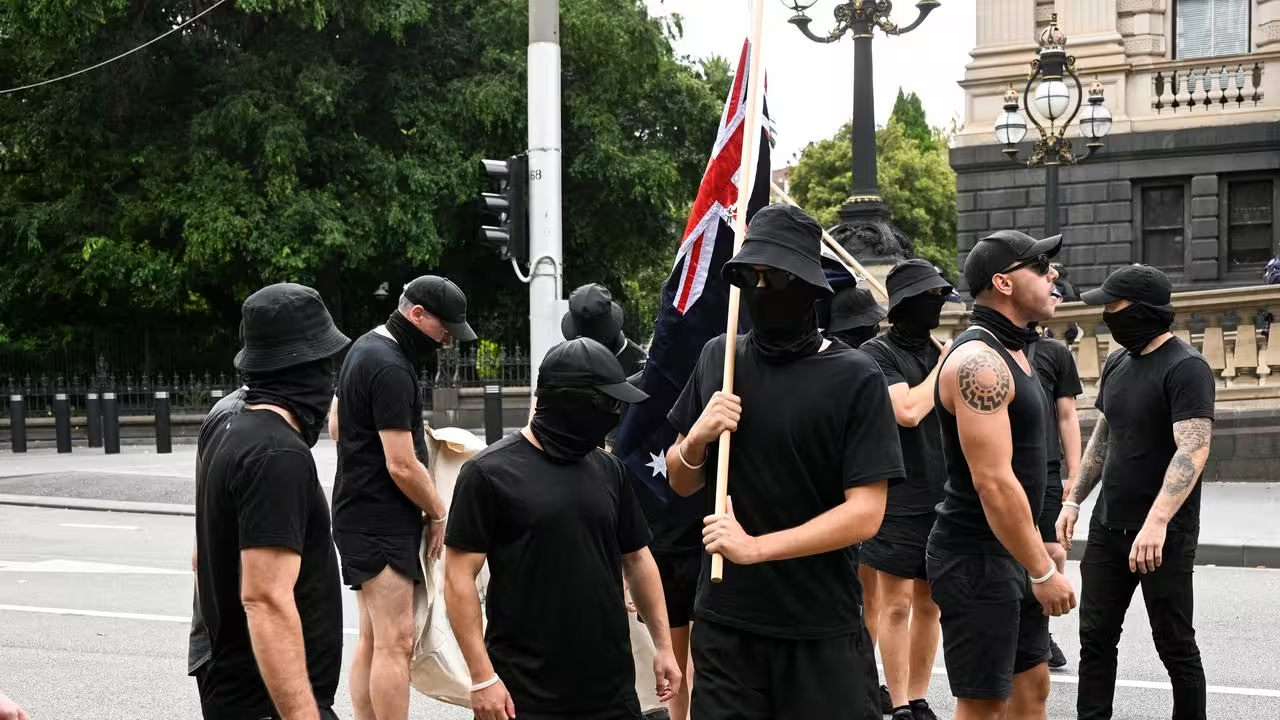
Australia’s most prominent neo‑Nazi organisation, the National Socialist Network (NSN), has announced it will fully disband by January 18, 2026, in response to an intensified federal government crackdown on hate speech and extremist groups. The group’s dissolution precedes the expected passage of new legislation designed to empower authorities to ban and prosecute hate organisations. This development follows broader efforts by the government to tackle rising extremist threats in the wake of recent violent incidents, marking a significant milestone in Australia’s domestic security approach.
What Led to the Disbandment of the NSN?
The NSN — long characterised by neo‑Nazi ideology and white supremacist rhetoric — announced via its social media channels that it would cease operations to avoid prosecution under new federal hate speech laws expected to be debated in the Australian Parliament next week.
The legislation, introduced in the aftermath of the Bondi Beach terror attack that killed 15 people in late 2025, seeks to broaden government powers to designate organisations as prohibited hate groups, criminalising membership, recruitment, training, and financial support. Under this framework, engaging with extremist groups could result in prison sentences of up to 15 years.
By announcing its disbandment before the new laws are enacted, the NSN is reportedly trying to shield its members from impending legal consequences — a move that some experts and officials view skeptically, given that individuals could still face prosecution for extremist activities prior to dissolution.
What Is the National Socialist Network?
The National Socialist Network has been one of Australia’s most visible far‑right extremist groups, promoting white supremacist ideology and engaging in public rallies and demonstrations. It has been linked to aggressive incidents, including vandalism and confrontations at protests. Prior to its disbandment announcement, the group also pursued plans to form a political party under various affiliated movements such as White Australia, the European Australian Movement, and the White Australia Party — all set to dissolve alongside the NSN.
Authorities have long monitored the NSN because its activities and rhetoric have raised concerns around social cohesion, public safety, and the potential for radicalisation. Its disbanding — even if intended to avoid legal and criminal consequences — represents an important shift in how extremist entities respond to legal pressure.
Australian Government’s New Hate Speech and Extremism Laws
The federal government, led by Prime Minister Anthony Albanese, has fast‑tracked new hate speech and extremism legislation as part of a broader security response following the Bondi terror attack in December 2025 — an event that reignited debates about domestic extremism and the adequacy of existing laws.
The proposed law would create a lower threshold for government designation of hate groups, enabling authorities to outlaw organisations that currently operate below traditional terrorist thresholds. Home Affairs Minister Tony Burke has named the NSN and other groups like Hizb ut‑Tahrir as potential targets for proscription.
If passed, these laws would:
- Make it illegal to direct, recruit for, or be a member of prohibited hate groups.
- Criminalise the provision or receipt of training for extremist causes.
- Enable the government to prosecute financial support for hate groups.
- Impose penalties including up to 15 years in prison for key offences.
Officials argue that such measures are necessary to prevent the spread of violent ideologies and protect vulnerable communities.
Reactions From Government and Security Officials
Home Affairs Minister Tony Burke welcomed the NSN’s announcement, stating that the government remains committed to keeping “hateful organisations off Australian streets.” However, he warned that individuals associated with these movements will still be monitored and prosecuted where possible.
Security agencies, including the Australian Security Intelligence Organisation (ASIO), have affirmed their role in tracking extremist behaviour and advising on legislative frameworks that can mitigate threats. Intelligence leaders also support mechanisms allowing for the proscription of groups before they escalate into violent or destabilising forces.
Still, some legal and civil rights advocates express concern that broad hate speech laws could affect freedom of expression, raising questions about where the line should be drawn between speech and criminal conduct. Despite these debates, the government maintains that its measures focus on conduct and organised hate, not lawful dissent or opinion.
Public and Community Responses
Reactions across Australia have been mixed. Many community groups and civil society organisations have praised the government’s firm stance against extremist ideologies, framing the NSN’s disbandment as a “victory for social cohesion” and a deterrent to similar groups.
Conversely, some commentators and political figures argue that such laws must be implemented carefully to ensure they do not inadvertently suppress legitimate political discourse or strengthen underground networks that could re‑emerge under different names. Critics point out that disbandment on paper does not necessarily eliminate the influence or networks of individuals committed to extremist beliefs.
What This Means for Extremism in Australia
The NSN’s disbandment marks a significant moment in Australia’s fight against domestic extremism. Although the group will no longer operate publicly, analysts caution that ideological movements can persist covertly or under altered identities, potentially undermining the impact of prohibition laws unless complemented by community engagement and deradicalisation efforts.
Strong enforcement will be key to ensuring that former members do not regroup or continue to propagate hate through unregulated channels. Authorities have stressed that broader intelligence, police monitoring, and legal tools will continue to be used to combat extremist threats.
Conclusion
Australia’s crackdown on extremist organisations has forced one of its most notorious neo‑Nazi groups, the National Socialist Network, to disband ahead of comprehensive hate speech legislation. While this development is being hailed as a policy success by government officials and community leaders, it also underscores the ongoing challenges democracies face in balancing civil liberties with effective measures against hate and violence. As the new laws move through Parliament, Newsifyx will continue to monitor debates, implementation, and broader implications for national security and civic life in Australia.
FAQs
Why is the National Socialist Network disbanding in Australia?
The National Socialist Network announced it would disband ahead of new federal hate speech laws that would allow the government to ban extremist organisations and impose heavy prison sentences for related offences.
What new laws are prompting this disbandment?
Australia’s proposed hate speech and extremism legislation would lower the threshold for designating groups as prohibited hate organisations, making recruitment and membership criminal offences.
What penalties do the new laws include?
Under the proposed laws, directing or being a member of a prohibited hate group could carry penalties of up to 15 years in prison.